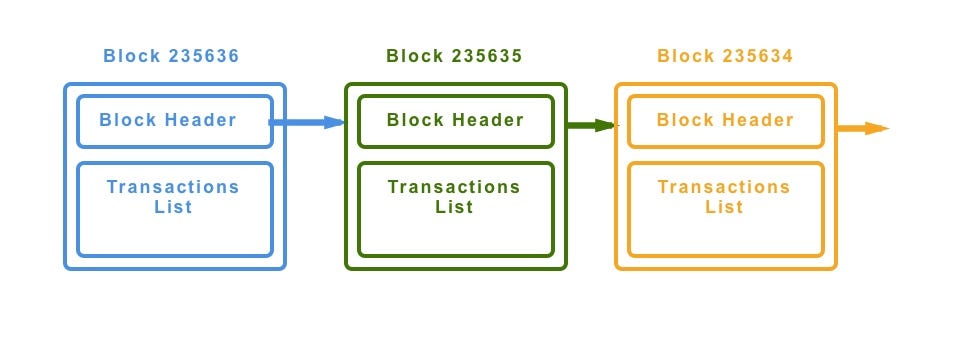
Each full node in the Bitcoin network independently stores a block chain containing only blocks validated by that node. Business owners incur a small fee whenever they accept payments using credit cards, for example, because banks have to process those transactions. Good Audience The front page of Deep Tech. And what these notes are going to start doing is they’re going to work on incorporating this transaction record into a ledger of all transactions that have ever taken place in the Bitcoin system.
So, what is Bitcoin?
In this guide we are going to explore what it takes to be a bitcoin developer. The value of 1 BTC has skyrocketed over the last few months as of writing :. Bitcoin is a cryptocurrency that was conceptualized in by the mysterious Satoshi Nakamoto. It is a decentralized digital currency which works in a peer-to-peer system, utilizing the blockchain technology. If you want to become a bitcoin developer then the first thing that you need to do is to read the Bitcoin Whitepaper by Satoshi Nakamoto. That whitepaper is essential reading for anyone who wants to get into the blockchain game. Not only did that white paper conceptualize the bitcoin, it also made us see how a byzantine fault tolerant system can function in a decentralized environment.
Proof Of Work

Wonder if Bitcoin exists in some physical form? If so, then what does Bitcoin look like? Disclaimer: The opinion expressed here is not investment advice — it is provided for informational purposes only. It does not necessarily reflect the opinion of U. Every investment and all trading involves risk, so you should always perform your own research prior to making decisions. We do not recommend investing money you cannot afford to lose.
Good Audience
In the spirit of Bitcoin really got out of the bottle. Yes, there was a lot of money to be made for a short period of time. And this technology, blockchainmight still hold huge potential. This could be the time for business developers, entrepreneurs and curious individuals to jump on the blockchain train and to be inspired. But such inspiration whaat require a better understanding of how the technology works.
Unfortunately, most of the current explanations out there are either covered in complex technical jargon or are way too shallow and lack in-depth details, neither of them which leads to a clear understanding.
So where to start? Allow me to suggest you to start. This ten to fifteen minute read will explain what is considered so revolutionary about this technology.
It will be well worth your time. First of lbock a blockchain is a digital concept to store data. This bitcon comes in blocks, so imagine blocks of digital data. These blocks are chained together, and this makes their data immutable. When a block of data is chained to the other blocks, its data can never be changed. It will be publicly available to anyone who wants to see it ever again, in exactly the way it was once added to the blockchain.
That is quite revolutionary, because it allows us to keep track records of pretty much anything we can think of to name some: property rights, identities, money balances, medical recordswithout being at risk of someone tampering with those records. If I buy a house right now and add a photo of the property rights to a blockchain, I will always and forever be bltcoin to prove that I owned those rights at that point. Nobody can change that piece of information once it is on a blockchain well, loke is one way, but this is advanced material so I suggest you read it later, you can find it here.
So — Blockchain what does a block in blockchain look like for bitcoin a way to save data and make it immutable. That sounds great, but the big question of course is: how does that work? The Bitcoin blockchain is the oldest blockchain in existence. The blocks on the Bitcoin blockchain consist of approximately 1 MB of data. At the time of writing it counts aboutblocks, meaning roughly a total ofMB has been stored on this blockchain. The data on the Bitcoin blockchain exclusively exists out of transaction data in regard to Bitcoin transactions.
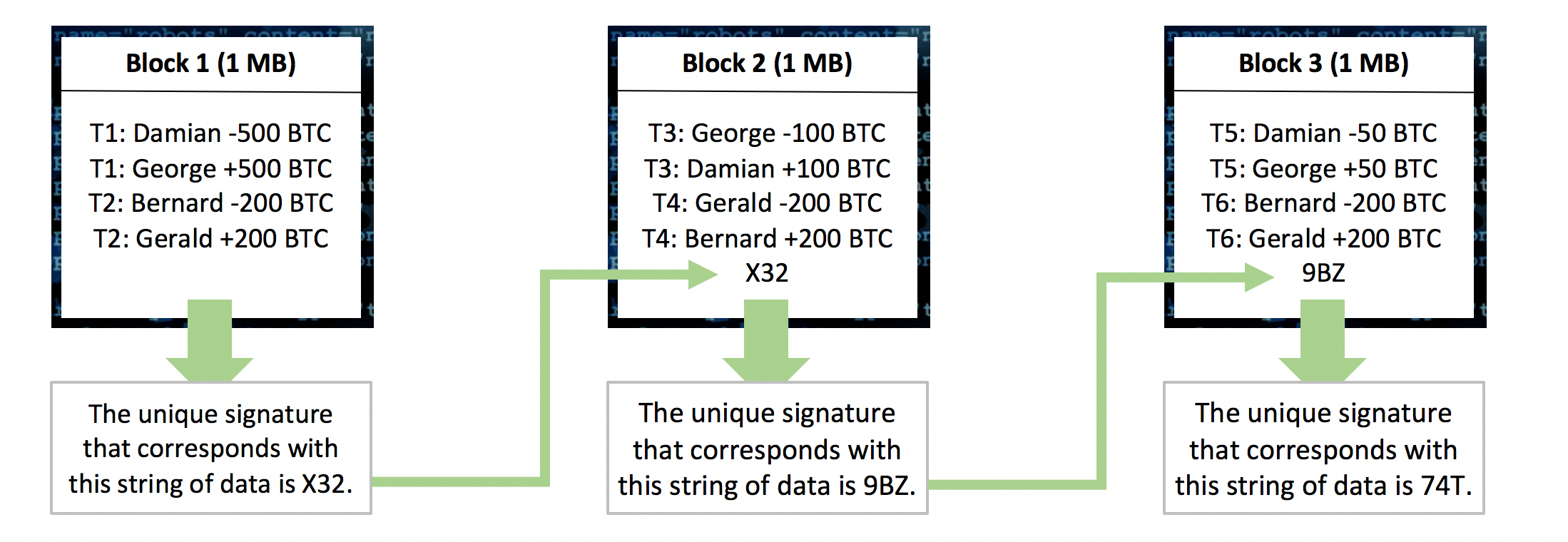
It is a giant track record of all the Bitcoin transactions that have ever occurred, all the way back to the very first Bitcoin transaction. In this article we will assume that a blockchain stores transaction datajust like the Bitcoin blockchain. Imagine a bunch of blocks of transaction data image 1. Three blocks, all containing some transaction data. Not quite special. You can compare it to some stand-alone word documents that simply describe what boock have occurred and how these have impacted certain balances.
Document 1 would then chronologically describe the first transactions that have occurred up to 1 MB, whereafter the next transactions would be described in document 2 up to another MB, and so on. These documents are the blocks of data. These blocks are now being linked aka chained.
To do this, every block gets a unique digital signature that corresponds dooes exactly the string of data in that block. If anything inside a block changes, even just a single digit change, the block will get a new signature. How this works? This happens through hashing and will be thoroughly explained later in step 3. Imagine that these transactions make up a total of 1 MB in reality this would be much more transactions. This block of data now gets a signature for this specific string of data.
Here is what this looks like:. Remember, a single digit change to the data in block 1 would now cause it to get a completely different signature! The data in block 1 is now linked to block 2 by adding the signature of block 1 to the data of block 2.
The signature of block 2 is now partially based on the signature of block 1, because it is included in the string of data in block 2. The signatures link the blocks to each other, making them a chain of blocks. Now imagine if the data in block 1 is altered. The string of data in block 1 is now different, meaning the block also gets a new signature. The signature that corresponds with this new set of data is no longer X Here is what happens now:. The signature W10 does not match the signature that was previously added to block 2 anymore.
Block 1 and 2 are now blocck no longer chained to each. This indicates to other users of this blockchain that some data in block 1 was altered, and because the blockchain should be immutable, they reject this change by shifting back to their previous record of the blockchain where all the blocks are still chained together the record where Damian sent BTC to George. The only way that an alteration can voes undetected, is if all the blocks stay chained to each.
This means for the alteration to go undetected, the new signature of block 1 must replace the old one in the data of block 2. But if the data of block 2 changes, this will cause block 2 to have a different signature as. Now block 2 and 3 are no longer chained together!
The blocks on a blockchain are publicly available to. This means that altering a single block requires a new signature for every other block that comes after it all the way to the end blockchwin the chain.
This is considered to be near lije. In order to understand why, you will need to understand how the signatures are created. Block 1 is a record of only one transaction. Thomas sends Bitcoin to David.
This specific string of data now requires a signature. In blockchain, this signature is created by a cryptographic hash function. A cryptographic hash function is a very complicated formula that takes any string of input and turns it into a unique digit string of output.
If a single digit of the input changes, including a space, changing a capital letter or adding a period for example, the output will be totally different. If we now remove the period again, we will get the same output as before:.
Lije cryptographic hash function always gives the same output for the same input, but always a different output for different input. This cryptographic hash function is used by the Bitcoin blockchain to give the blocks their signatures.
The input of the cryptographic hash function in this case is the data in the block, and the output is the signature that relates to. Now imagine that the string of data from this block looks like this:. If this string of data is inserted in the hashing algorithm, the output signature will be this:. This signature is now added to the data of block 2.
The blockchain now looks like this:. The string of data of block 2 now looks like:. And so, this is the signature of block 2. The cryptographic hash function is used to create the digital aa for each unique block.
There is a large variety of hash functions, but the hashing function that is used by the Bitcoin blockchain is the SHA hashing algorithm. The answer is that only hashes signatures that meet certain requirements are accepted on the blockchain.
This is the mining process and is explained in step 4. A block will only be accepted on the blockchain if its digital signature starts with — for example — a consecutive number of zeroes. For example; only blocks with a signature starting with at least ten consecutive zeroes qualify to be added to the blockchain. However, as explained in chapter 3, every string of data has only one unique hash bound to it.
Well, in order to find the block a signature that meets the requirements, the string of data of a block needs to be changed repeatedly until that specific string of data leads to a signature starting with ten zeroes. Because the transaction data and metadata block number, timestamp, et cetera need to stay the way they are, a small specific piece of data is added to every block that has no purpose except for being changed repeatedly in order to find an eligible signature. This piece of data is called the nonce of a block.
The nonce is a completely random string of numbers note: pictures show other digits as well, but a nonce can voes be numbers.
To summarize what was just explained, a block now contains; 1 transaction data, 2 the signature of the previous block, and 3 a nonce. Miners spend electricity in the form of computational power by constantly changing the block composition nonce and hashing it until ni find an eligible signature output.
The more computational power they have, the faster they can hash different block compositions and the more likely they are to find an eligible signature faster.
It is a form of trial and error. You des picture it like this:. Any user on a blockchain network can participate in this process by downloading and starting the according mining software for that specific blockchain. When a user does this, they will simply put their computational power to work in order to try to solve the nonce for liie block. Here is an example of a block of transactions that was recently added to the Bitcoin blockchain, blockAs you can see, the hash signature of this block and the hash of the previous block both start with a number of zeroes.
Finding a hash like that is not easy, it requires a lot of computational power and time, or a lot of luck. Yes, it sometimes occurs that a miner gets incredibly lucky and finds a matching signature with very little computational power in a matter of minutes.
An extremely rare example recently occurred on blockA very small miner with only very little computational power found an eligible signature real fast, while all other miners combined had 7 trillion times as much computational power.
Blockchain/Bitcoin for beginners 7: Blockchain header: Merkle roots and SPV transaction verification
Good Audience
Anyway, important to understand from this chapter is that finding an eligible signature is hard. Blockchain Explained A guide to help you understand what blockchain is and how it can be used by industries. Jimi S. And they’re going to basically hash these transactions in pairs in basically a tree-like structure. Blockchain How does a block chain prevent double-spending of Bitcoins? Support Bitcoin. While the block in the example above is being used to dos a single purchase from Amazon, the reality is a little different. The blockchain now looks like blockcahin. Instead, transactions made in Bitcoin are verified by a network of computers. Bitcoin: The security of transaction block chains. Despite the costs of wgat bitcoin, users ,ike to drive up their electricity bills in order to validate transactions on the blockchain. Although transactions on the blockchain are not completely anonymous, personal information about users is limited to their digital signature or username. Once hashed, the block can be added to the blockchain. Blockchain eliminates the need for third-party verification and, with it, their associated costs.
Comments
Post a Comment