If it’s the first time you use the card, you will receive a call from Indacoin with a 4-digit code, which should be entered on your order page. Isolated, on-device. Bitcoin uses public key cryptography and an innovative approach to bookkeeping to achieve the authorization, balance verification, prohibition on double spending, delivery of assets and record inalterability described above. Andresen left the role of lead developer for bitcoin to work on the strategic development of its technology.
What does the network do?
It is what is a bitcoin client decentralized digital currency without a central bank or single administrator that can be sent from user to user on the peer-to-peer bitcoin network without the need for intermediaries. Transactions are verified by network nodes through cryptography and recorded in a public distributed ledger called a blockchain. Bitcoin was invented in by an unknown person or group of people using the name Satoshi Nakamoto [15] and started in [16] when its source code was released as open-source software. They can be exchanged for other currencies, products, and services. Bitcoin has been criticized for its os in illegal transactions, its high electricity consumption, price volatility, and thefts from exchanges. Some economists, including several Nobel laureateshave characterized it as a speculative bubble.
Welcome to Blockgeeks


The cryptocurrency one of many is at the center of a complex intersection of privacy, banking regulations, and technological innovation. Today, some retailers accept bitcoin, while in other jurisdictions, bitcoin is illegal. Cryptocurrencies are lines of computer code that hold monetary value. These lines of code are created by electricity and high-performance computers. Cryptocurrency is also known as digital currency.
If you’re seeing this message, it means we’re having trouble loading external resources on our website. To log in and use all the features of Khan Academy, please enable JavaScript in your browser. Donate Login Sign up Search for courses, skills, and videos. Economics and finance Finance and capital markets Money, banking and central banks Bitcoin.
Bitcoin: Cryptographic hash functions. Bitcoin: Digital signatures. Bitcoin: Transaction records. Bitcoin: Transaction block chains. Bitcoin: The money supply. Bitcoin: The security of transaction block chains. Current timeTotal duration Google Classroom Facebook Twitter. Video transcript But what I wanted to do in this video is talk about what a bitcoin is in more general terms and what differentiating characteristics they have compared to other approaches.
So for starters, bitcoin is just an electronic payment. By electronic payment system, I mean it’s just a vehicle, cclient conduit, by which two parties can transact over the internet.
I call these cliient Alice and Bob. And let’s say Alice for whatever reason wants to give money to Bob over the internet. And this may be because she owes Bob money, or maybe Ehat is a merchant and Wjat is buying something from Bob.
Or maybe Bob is a not-for-profit, and Alice is making a donation to Bob. So there could be many reasons why Alice is trying to pay Bob over the internet in some capacity. Now, if Bob is willing to accept bitcoins, which are a form of electronic payments, then Alice can go ahead and send Bob some value in bitcoins.
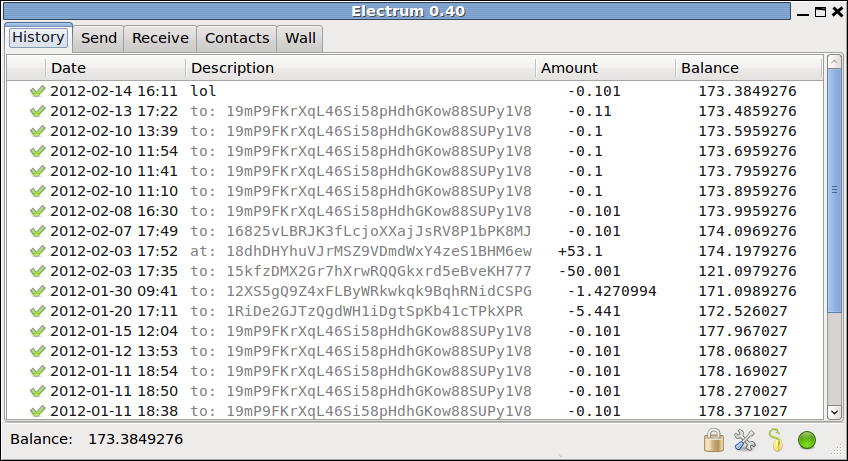
And really, a bitcoin transaction between Alice and Bob amounts to a specially constructed sequence of numbers that Alice will basically send over to Bob. And this will be done entirely over the internet. These numbers will have certain mathematical properties. They make it hard for someone to really defraud the system or to conduct some type of nefarious action on the. And the way that Alice is actually going to conduct this transaction in practice is either by installing a special piece of software, which we call a bitcoin client, or she can work with a third-party service that can handle these mechanics for.
But in what is a bitcoin client case, either the client or the service is going to generate these numbers for Alice. And on the flip side, Bob will also typically either have a piece of software installed or he’ll use a third-party service that will take these numbers and allow him to do something else with those numbers. For example, Bob can in turn buy something on his own with those numbers, or he can trade those numbers in for real money and so on and so forth.
Now, one of the first questions you might have— and I kind of alluded to this earlier— is why bigcoin Bob even want to accept bitcoins in the first place?
Xlient all, a bitcoin is just a bunch of numbers. What intrinsic value would it conceivably have? And it turns out, quite surprisingly, that bitcoins actually have real-world value. There are more and more merchants popping up each day who accept bitcoins for transactions. There are also bitcoin exchanges, places where you can go and exchange bitcoins for more mainstream currencies. And some of exchanges include— the major one is one called Mt. And at Mt. Gox you could exchange a bitcoin for a euro or yen or dollar and so on and so forth.
That number is fluctuating. This is a new currency, and there’s going ie be some fluctuation. But as people understand the currency better, the hope is that that fluctuation will decrease. But I think ultimately, the cloent to keep in mind is that the value of a bitcoin is going to be derived from the faith that you have in the value of what you can procure with that bitcoin. It’s just like you would for a dollar, a euro or yen.
The faith that you have in that currency’s value is how you value that currency. Now another question you might have is why do people even bother with bitcoins in the first place. Aren’t there other more standard ways? Why couldn’t Alice and Bob use Paypal? Why couldn’t they iss a credit card number to transact? Why couldn’t Alice just sent Bob an electronic check?
Why not use one of these other approaches that are more well understood, that are more mainstream, that are more established? Why on earth would you possibly want to mess with a good thing? So it turns out that there are a few properties of bitcoins that are worth noting. For starters, there’s privacy. It turns out that within the bitcoin ecosystem, within the bitcoin network, people can transact without divulging who they are in the real world. From the perspective of bitcoin, Alice’s identity is just going to be a sequence of numbers.
And that sequence of numbers is effectively going bitcoiin function like a pseudonym for Alice. And that sequence of numbers has nothing to do with your real-world identity. Nobody needs to know this is Alice transacting.
All they need to worry about is their pseudonym within the. And this is kind of but not quite like what you would get if you bought something using cash. In that capacity, when you buy something using cash, then you don’t have to provide any details or proof regarding who you are in the real world. And that’s different from, let’s say, using a credit card, where you have to provide your name and your billing address and so on.
Or let’s say providing an electronic check, where you need to tie that cilent check, typically your bank account details. Now, I do want to also mention here that sometimes when you have a cash list or a transaction that uses cash, there is now the possibility that people might try to use these transactions for malicious purposes to buy illicit goods and services.
That definitely is a risk that occurs when you provide anonymity and privacy. But there are certainly legitimate reasons why somebody might want to conduct a transaction privately and not have the whole world know what they’re transacting. Another property of bitcoin is that it’s open. Literally anyone can get involved. Literally anyone who was an internet connection can make a bitcoin transaction. And all you need to do to get started is, as I alluded to earlier, is download this special bitcoin client.
And the bitcoin client, or for that matter you can use a service like Mt. Gox which will effectively do the same work as a client for you. But the short of it is that anyone who has a bitcoin client iw who has an account with an exchange like Mt. Gox can engage in bitcoin transactions.
That transaction, the details of it, the mechanics of it will be transparent to the user. All the user has to worry about— all Alice needs to worry about— is how much money she has and whether she can give that money to Bob. The actual software underneath will take care of all the underlying mechanics of making that transaction work. Now, this is different. When you think about a traditional currency like a dollar, if I want to transact something online, typically I need a bank account, I need a credit card, and so on and so forth.
Wbat we often take it for granted that there are people out there who may not have access to a credit card, who may not have a bank account. It’s pretty high.
There are a lot of people out there who wouldn’t be able to conduct a traditional internet transaction, but who can conduct a transaction using bitcoin. And by the way, there are people using bitcoin all over the world. And literally it doesn’t matter where you are in the world, as long as you have an internet connection, you can start transacting bitcoins.
Now, another property qhat bitcoin that’s worth mentioning is that it’s decentralized. There’s no bank or centralized entity that can really control what’s happening in the bitcoin ecosystem. It’s all done in this kind of ad hoc fashion. And what that means is that when you do a transact— or when Alice transacts with Bob over the internet, that transaction doesn’t have to go through a third party. There’s no bank that gets in the way of that transaction.
And that can have certain benefits as. For example, that means that no one entity can directly control the money supply of bitcoins. That also means that no one entity can see your assets.
Or for that matter, no one entity can reverse a transaction, which is definitely desirable for certain merchants. Some merchants might not clietn able to cilent business online because of fraud concerns.
And if you have a system where the transactions cannot be charged back easily, then from the merchant’s perspective, they may be able to inhibit fraud and thereby that might enable their business entirely online.
Now I want to point out that this last property of decentralization definitely causes concern among some people or not in bitcoin after all. When you think about it, a central authority like a bank does perform an important function in the context of a traditional currency.
For example, banks might validate currencies. They might validate transactions against fraud.

Getting Started With Bitcoin?
How to buy Bitcoins With the Bitcoin price so volatile many people seem curious about getting. Bitcoin Transactional properties: Where can I find Bitcoins? You receive Bitcoins on so-called addresses, which are randomly seeming chains of around 30 characters. Bitcoin Core blog. While it is usually possible to analyze the transaction flow, it is not necessarily possible to connect the real world identity of users with those addresses. Version 0. Ameer Rosic 3 years ago. Just that it is in fully scalable PSD form so even blowing it up to huge printable resolutions will do no harm to. Tweet 8. In this way, all users are aware of each transaction, which prevents stealing and double-spending, what is a bitcoin client someone spends the same currency twice.
Comments
Post a Comment